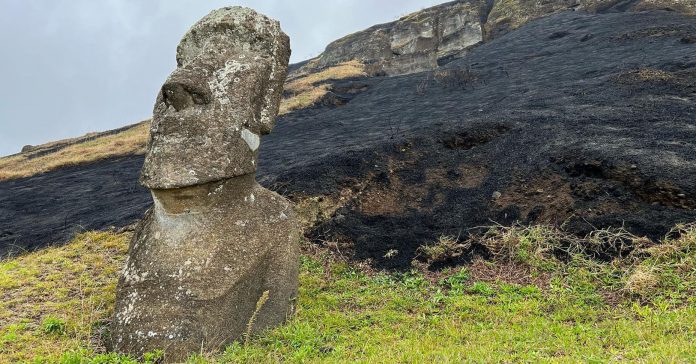
This October 4th we commemorate in Rapa Nui a devastating event that, a year ago, affected the Rano Raraku quarry, as a result of a fire. This is one of the most important archaeological sites on the island, since it is the quarry in which the Moai were carved, one of the iconic elements and witnesses of a rich cultural tradition. It is precisely these sculptures that attract the attention of the thousands of visitors who travel from remote places every year to see Rapa Nui.
This tragic event has caused considerable damage to some Moai, other archaeological resources, and the environment, resulting in serious damage and accelerated drying of the wetland in the volcano's crater. This result is the product of irresponsible practices that have affected the island for several years.
After the fire, UNESCO created the “HEF Rapa Nui” project to assess the damage and manage the risks of the site, in collaboration with MA´U HENUA, current administrator of the Rapa Nui National Park. In this way, a local team of professionals carried out a detailed diagnosis of the affected features, which produced results and some recommendations, among them, the urgency of intervention of at least 22 Moai. The next step is the creation of a pilot Risk Plan for Rano Raraku, focused on fire risk, which is in its final stage.
Given this situation, it is time to become aware, stop these burnings that cause more harm than good and discuss the importance of protecting our heritage and the actions we must take to prevent future fires on Rapa Nui.
It is essential to open our eyes and recognize the damage we cause through grassland burning that, once uncontrolled, escapes from our hands, consuming part of the territory. Fires not only affect archaeology, but also human lives, biodiversity, property, air and soil, and contribute to aggravating the consequences of climate change.
We must stop the burning and take action to protect our land and heritage. May our legacy to future generations be the concern and care of our Rapa Nui, and that they can enjoy their heritage just as our ancestors left it. Māuru-uru